Neuroscience
-
- Ingrid Reiten,
This email address is being protected from spambots. You need JavaScript enabled to view it. - Archana Golla,
This email address is being protected from spambots. You need JavaScript enabled to view it. - Jan G. Bjaalie,
This email address is being protected from spambots. You need JavaScript enabled to view it. - Trygve B. Leergaard,
This email address is being protected from spambots. You need JavaScript enabled to view it.
- Ingrid Reiten,
- CS Organisations:
- University of Oslo , CS Organisation Logo:
 , http://www.med.uio.no/imb/english/
- University of Oslo , CS Organisation Logo:
-
- Neuroscience OpenAIRE Gateway, https://neuroscience.openaire.eu/
- Scientific Knowledge Graph for Neuroscience Research, https://doi.org/10.5281/zenodo.18471146
- BIP! User Interface, https://bip.imsi.athenarc.gr/search/neuroscience-pilot
The SciLake Neuroscience pilot bridges the European research infrastructure EBRAINS with SciLake's innovative services. It is led by researchers at the University of Oslo who are members of the EBRAINS data curation team.
At the heart of this initiative is the EBRAINS Knowledge Graph (https://search.kg.ebrains.eu), which hosts an impressive collection of over 1,100 curated datasets generated using a range of structural, functional, and molecular methods related to brain research. Our mission is to enhance this valuable resource by connecting it with neuroscience publications from the OpenAIRE Graph and enriching it with automated impact metrics and domain-specific metadata.
The project is developing an enhanced Scientific Knowledge Graph (SKG) for Neuroscience that combines SciLake's analytical capabilities with EBRAINS' and OpenAIRE’s extensive data resources. This integration will enable researchers to conduct innovative queries related to neuroscience research and monitor citation impacts across datasets and publications, and it will allow services to identify emerging trends and optimize data sharing and curation processes.
The SKG developed through the pilot will be made publicly available through the SciLake user interface "Bip! Finder" along with integrated impact indicators.
What we have achieved
The pilot’s journey has involved the following key steps:
- Enriched the existing Neuroscience OpenAIRE Gateway to incorporate related research products, additional data sources, projects, and subjects and provided input on how data are represented. This gateway is configured to consolidate research outputs from neuroscience repositories and infrastructures. The journals selected as relevant for the neuroscience pilot were based on an established list (https://research.com/journals-rankings/neuroscience). The selected data repositories were endorsed by the International Neuroinformatics Coordinating Facility.
- Identified and addressed improvements needed in the OpenAIRE Graph, including fixing issues with duplicate listings and versioning information.
- Developed the first version of the new SKG for neuroscience research, integrating metadata from EBRAINS and other repositories using the openMINDS framework. This is available as an AvantGraph instance and via the user interface https://bip.imsi.athenarc.gr/search/neuroscience-pilot
- Implemented SIRIS' data mining functionalities to connect datasets with relevant publications: extracted the openMINDS controlled terms ExperimentalApproaches, Techniques, PreparationTypes, Parcellations, BiologicalSex and Species from open access publications so that these could be linked to datasets with the same metadata Experiment with SKG contents (using AvantGraph queries, Lake API queries, BIP! Spaces UI, or/and SciNoBo assistant UI)
- Published the Scientific Knowledge Graph for Neuroscience Research as a dataset based on the OpenAIRE SKG-IF representation, providing core entity nodes and relationships for Agents, Data sources, Grants, Products, Manifestations, Topics, and Venues.
Related News
- Presentation: The EBRAINS Data & Knowledge services: exploring synergies with EU’s SciLake project, presented at the workshop “Open Science Knowledge Graphs: Transforming the Way we Manage, Explore, and Analyze Scientific Knowledge” at Open Science FAIR 2023.
- Press release: EBRAINS and SciLake collaborate to improve data services for neuroscience research
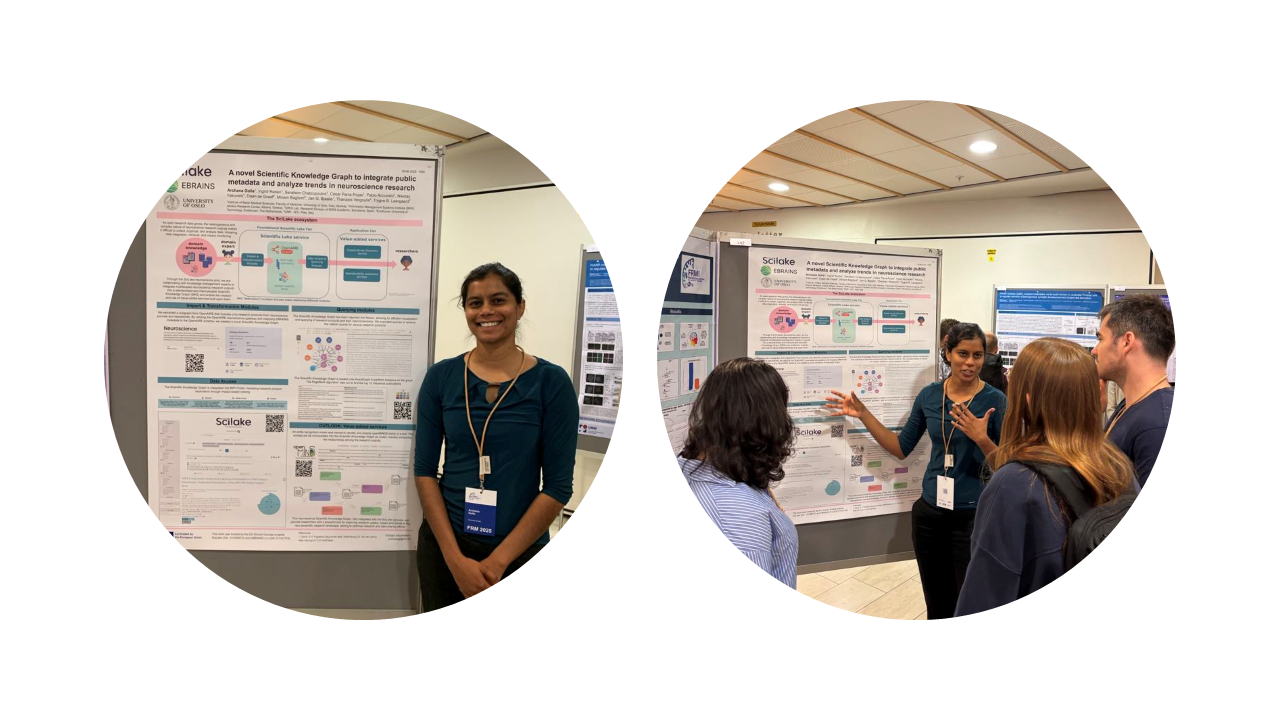
- Presentation: A Novel SKG to Integrate Public Metadata and Analyse Trends in Neuroscience Research, presented at FENS Regional Meeting 2025.Presentation: Merging Services for a Novel Neuroscience Knowledge Graph: Enhancing Data Integration and Tracking Research Impact, presented at EBRAINS Summit 2025.
- Presentation: Exploring an Integrated Neuroscience SKG: Interlinked Outputs, Shared Entities, and Impact IndicatorsFinal SciLake dissemination event (March 2026)
- Press release: Connecting Science: Bridging Knowledge Borders Through Knowledge Graphs (April 2026)
- Press release: EBRAINS Advances European Effort to Connect Scientific Research Through Knowledge Graphs (May 2026)